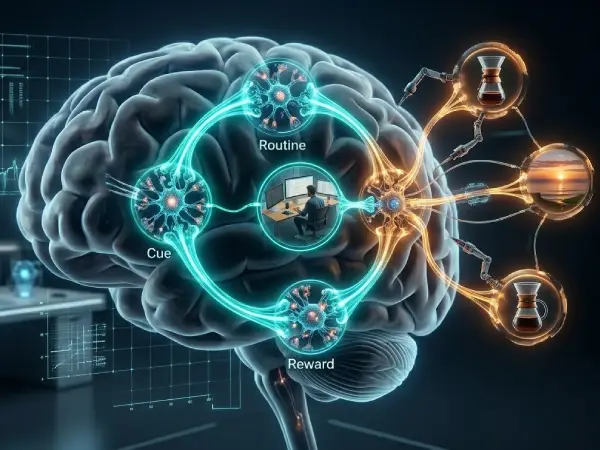
Most people think behavior change is about motivation or discipline. But science shows something simpler—and more powerful: your life is run by loops, not decisions.
Every habit you have, from checking your phone to brushing your teeth, follows a predictable neurological pattern called the habit loop. Once you understand it, you can stop fighting your behavior and start redesigning it.
Let’s break down how the habit loop works—and how to hack it like a pro.
1. The Habit Loop Has 3 Parts
Every habit runs on a simple cycle:
- Cue (Trigger): What starts the behavior
- Routine (Action): What you do
- Reward: What your brain gets from it
Your brain repeats this loop because it wants efficiency and reward with minimal effort.
Key insight: Habits are automated reward systems.
What to do: Identify all three parts of your current habits.
2. The Cue Is the Real Control Switch
Most people focus on behavior, but the real power lies in the cue. Triggers can be emotional (stress), environmental (phone on desk), or situational (after eating).
If you don’t control the cue, you don’t control the habit.
Key insight: Triggers create automatic behavior.
What to do: Notice what happens right before the habit starts.
3. The Brain Craves Rewards, Not Logic
Your brain doesn’t repeat habits because they are logical—it repeats them because they feel rewarding. Even unhealthy habits provide some form of satisfaction (relief, distraction, comfort).
This is why willpower alone fails.
Key insight: Emotion beats logic in behavior loops.
What to do: Identify the hidden reward behind your habit.
4. Replace the Routine, Keep the Cue
You don’t need to eliminate the habit loop—you only need to change the middle part. If you keep the same trigger and reward but change the action, you can rewire behavior.
This is the most effective habit change strategy.
Key insight: Same trigger + new action = new habit.
What to do: Swap unhealthy routines with better alternatives.
5. Make Good Habits Obvious
If a cue is hidden or unclear, the habit won’t form. Visibility is one of the strongest behavior triggers.
The easier it is to notice, the more likely it will happen.
Key insight: Visibility drives repetition.
What to do: Place reminders or tools in visible locations.
6. Make Bad Habits Invisible
The opposite also applies. If you remove or hide triggers, the habit weakens over time. Out of sight reduces temptation.
Small environmental changes create big behavioral shifts.
Key insight: No cue = no habit loop.
What to do: Remove or block access to triggers.
7. Reinforce the New Reward
Your brain must feel that the new behavior is worth repeating. Without a reward, new habits fade quickly.
Even small positive reinforcement helps strengthen the loop.
Key insight: Reward locks in behavior change.
What to do: Add a small positive outcome after good habits.
Final Thoughts
The habit loop explains why behavior feels automatic—and how it can be redesigned. You don’t need extreme discipline or constant motivation. You need awareness of triggers, control over routines, and smart reinforcement.
When you understand the loop, you stop being controlled by habits—and start designing them.
Because in the end,
your habits are not who you are—they are systems you can rewrite.